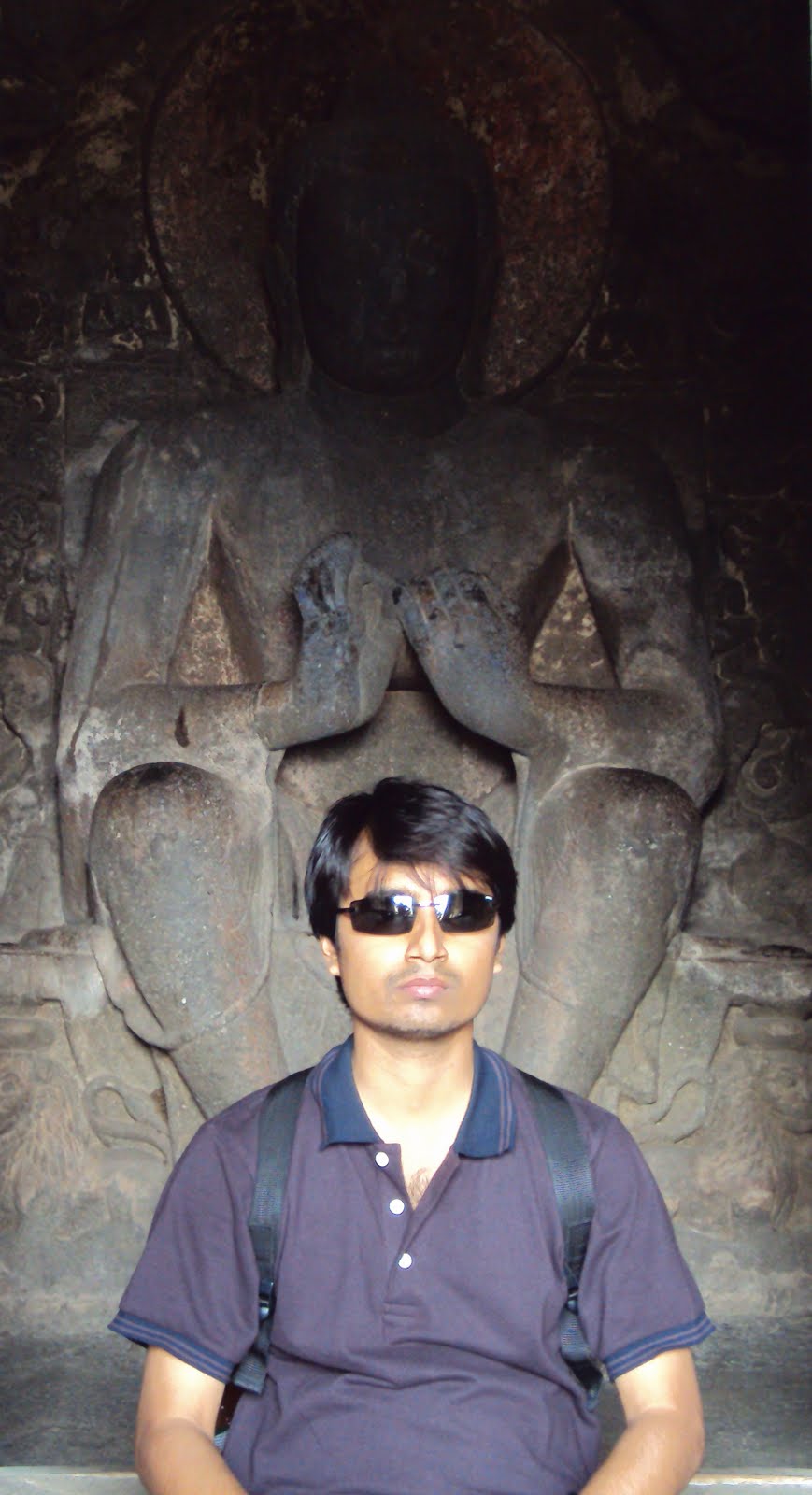
Christmas always provides a good time for vacation, since there is less work pressure, at least till I have clients based in the US (I sincerely hope to have the same opportunity next year also :-)). Srimanta and I went to a lovely trip of Gwalior, Orchha and Varanasi during the same time, the previous year and decided to visit the caves of Ajanta and Ellora this time round. To spend a few more days out, we expanded our itinerary and included Nasik as the starting place of our tour. I must admit, Savi and Madhu’s travel blog, 10yearitch.com, provided some wonderful inputs for this tour and following their posts, I became interested about Nasik which is otherwise not a very happening tourist spot.
The tour planning was not without any worry or initial hiccups. Firstly, there was a question mark on Srimanta’s availability as he was outside the country. However, he confirmed that he will return home a week before Christmas. Santu and Anirban became the other members of the tour gang and there were issues with them as well like whether Santu would be joining us from Mumbai and Anirban who was serving his notice period would be granted the leave. Thankfully, all of us could ultimately make the trip and the trip became more interesting and enjoyable this time with more people.
However, due to the indecision about who would be really going and who may miss out due to unavoidable circumstances, we could not book any hotel until about a week before the trip and at that time we felt the heat as we found a real scarcity of hotel rooms (at least the MTDC ones which we initially planned to book). Santu suggested looking for hotels on the spot, but I was apprehensive due to the fact that it was peak tourist season in Maharashtra. The Diamond Tours & Travels whose office we visited for booking MTDC hotels could not even book any private hotel for us in Nasik. Luckily I got a good deal on cleartrip.com and booked Hotel Rama Heritage and it turned out to be the best hotel in our entire trip.
We boarded the HWH CSTM Express in the afternoon of Friday, the 24th of December and we spent most of the journey playing cards. Anirban was carrying a deck of cards and just like hostel days we were so much engrossed playing 29 that we stopped in between long hours of play only for taking meals and toilet breaks. The train was right on time. We reached Nasik Road station in the evening of the following day and took an auto to Hotel Rama Heritage. It was a really good value for money experience. I booked two rooms at Rs. 1500 per room per night and even got near 30% money back from cleartrip.com later on. Just after we checked in, the hotel staff brought us some complimentary Christmas pastries and it set the tone of our pleasant stay at the hotel for the next couple of days.
The next morning, after the complimentary breakfast at the hotel, we took an auto to the Pandavleni caves. The auto left us at the foot of the Trivashmi hills, about 8 Kms from the city of Nasik and we climbed some steep steps to reach the caves. There were in total 24 caves dating back to 1st century B.C. and 2nd century A.D. The tourism website mentioned that the caves were home to Jain saints like Tirthankara Vrishabdeo, Veer Manibhadraji and Ambikadevi, but we found many Buddhist sculptures as well and one of them seemed to be the Mahanirvana of Buddha. A notice board put up by the Archeological Survey of India which maintains the place mentioned about inscriptions in the caves belonging to the period of Satavahanas and Kshatrapas but most of them except for a few caves had been eroded away.
Cave 13, an important cave in this group is the earliest of the caves and is a Chaitya Griha (prayer hall). All others are Viharas (monasteries). Caves numbered 3,8,10 and 23 are the other important caves. We had anticipated that we would be mesmerized by the caves of Ajanta and Ellora in this trip, but we thoroughly enjoyed these caves as well and it marked a good start of the tour. They reminded me of the Elephanta and Karla caves that I visited during my brief stint in Mumbai in 2006. The Chaitya Griha comprised the usual nave, apse and octagonal pillars and wood-like carvings over the doorway. Many of the sculptures were in good condition but undoubtedly many more had been looted away or vandalized with the passage of time.


Now as we were walking along the caves we stopped from time to time taking pictures of the sculptures as well as ourselves and with four cameras you can well imagine the time we spent on the photo session. And then people were taking snaps with and without sunglasses (I was the only one who had no choice but to stick to my pair of spectacles) and Santu was busy showing off his newly gym-acquired biceps and Srimanta kept bringing out his collection of caps (throughout the tour). In the midst of all this Santu suddenly realized that he had lost his camera bag somewhere in the caves and that brought the sleuths out of us. We checked the photos in each of our cameras and were certain that he left the bag at a stone carving of one of the caves while some one else was taking his photo and forgot to take it back. Now the question was which cave was it. After consulting some more photos which were taken just after that photo we could finally identify the cave and revisited it. The bag was lying peacefully at the very place that we anticipated along with our tickets and we made Santu promise to treat us to celebrate the discovery of the lost bag. The fact that Santu actually treated us later on (though he at first tried to play it down) and that the bill was far more than the cost of the bag would help us remember the incident for a long time :-)


After visiting the last of the caves, we rested for a while and watched the beautiful tableland across the hill that housed the caves, before we went down and visited the stupa styled Buddha Vihar located just at the bottom of the hills. It was a bit confusing to figure out the entrance of the Vihar. It has quite a massive dome in the centre and contains a huge golden statue of Buddha in the middle of a large meditation hall. The fascinating thing about the hall was that it created echo of the slightest of sounds, even of tapping of fingers. A photographer (who might be someone associated with the Buddha Vihar) was requesting people to maintain peace and not to make noise. However, quite a few people seemed to amuse themselves by the reverberations of the little sounds they were making and some of them were even coughing deliberately. At first I was wondering who would be paying that guy to take pictures at this kind of a place but to my amusement I found many groups (some of them being quite big to be an entire neighbourhood) assembling together to take group photos. After spending some time there, we moved on to the Dadasaheb Phalke memorial, which was located right next to the Buddha Vihar.

Dhundiraj Govind Phalke better known as Dadsaheb Phalke is known as the pioneer of Indian cinema. His debut film Raja Harishchandra (1913) is India’s first full length feature film. In his career span of 19 years he made 95 movies and 26 short films, mainly based on mythological stories of India. Today his name is associated with the prestigious Dadasaheb Phalke Award, instituted in 1969, the birth centenary year of Dadasaheb Phalke by the Government of India for lifetime contribution to Indian cinema, and is considered the highest award one can achieve in Indian cinema.

The memorial hall displays posters of Indian cinema right from the time of Raja Harishchandra to the most recent ones, like Lagaan, Swades and even Koi… Mil gaya.
Actually we had a tough time to locate the memorial hall. We first inquired about it from the local security men and they told us that it was closed as it was a Sunday. But when they pointed out the hall and suggested that we could still peek through the window panes, we found out that it was some other exhibition hall displaying archeological artifacts. Then when we mentioned that we were actually looking for the hall that consists of cinema posters, they realized the mix up and showed us the right hall. All the time it was extremely difficult to converse with them since they were speaking mainly in Marathi with a little bit of Hindi in between.
One can circumambulate the hall and see the posters in a chronological order starting from the earliest films and slowly moving on to the later ones. We could recognize the films and the artists only when we came to the period of Raj Kapoors and Dilip Kumars and Dev Anands. The posters of the major films of that era that I remember comprises Kabuliwala, Saheb Biwi aur Ghulam, Hum Dono, Naya Daur, Do Bigha Zameen, Bandini, Shree 420, Mother India and many more. Then were the posters of late 60s and 70s like Dev Anand’s Guide, Amitabh Bachchan’s Deewar and Kabhi Kabhie, Rajesh Khanna’s Aradhana and Anand and Sanveev Kumar’s Koshish. There was a section for the parallel cinema movement as well with posters of films like Paar and Ardh Satya. On the other end, posters from the movies of nineties and the new millennium were displayed. Though there were many standout films of recent times, still I would say that the selection of newer movies could have been a little bit more careful since there were a few forgettable movies finding their way in the hall.


At the centre of the hall, a section was dedicated to the three blockbusters of three generations considered to be the milestones of Indian cinema, namely Mughal-E-Azam, Sholay and Dilwale Dulhania Le Jayenge.


After we completed our tour of the Dadasaheb Phalke memorial, we had our lunch in a nearby hotel. The bearer who served us turned out to be a Bengali and it was nice to order in our native tongue in a place far away from our home. Our next destination was the pilgrimage spot at the heart of the old city of Nasik and we asked him for directions. He advised us to take a local bus to Panchvati. So we came back to the main road, had a paan each from a nearby paan shop and waited for the bus which arrived shortly. The surprising thing I noticed was that the bus conductors in Maharashtra gives out custom printed tickets from a small portable printing machine they carry which are not like the bundle of pre-printed tickets that we are accustomed to with bus conductors in Kolkata.
Panchvati is a significant holy place in Nasik and the legend goes that Lord Rama stayed there for some time with his wife Sita and brother Laxman during their 14 year exile. After reaching the place and inquiring with a few locals we realized that the whole area in general and not any specific spot is known as Panchvati.
We decided to visit the Ramkund first, where it is believed that Rama and Sita used to bathe. A holy tank was built at the place in 1696 by Chitrarao Khatakar and even today innumerous pilgrims gather there to take a holy dip. We even noticed some people to drink the holy water though it did not seem to be hygienic as the tank water was not very clean with people bathing all over and offerings of the devout scattered every where. Hindus, even today, immerse the ashes of a dead person in the holy tank so that the dead person attains moksha or liberation. The ashes of eminent personalities like Jawaharlal Nehru and Indira Gandhi have been immersed here.


I took a walk around the tank and through the middle of the vegetable market that is situated just beside the tank. There were countless small temples along the ghats and a few larger ones in the vicinity. A group of elderly men in typical Marathi attire were chatting around one of the temples. Beside another, a few middle aged women were singing bhajans. I stopped there for a few minutes to listen to them. Though I could not follow most of the words, the music was very appealing and created an impact together with the surroundings. Some women were washing clothes in another part of the tank and the already washed ones were spread out for drying on the steps of the ghats. And some young men were flying kites which is fast becoming a rare sport in the cities. I think I had spent more time than I anticipated wandering about the ghats and my friends began to call me up and asked to return to the place where I left them.


From the Ramkund, we took a narrow road to the Kalaram Temple which was built in 1794 by Gopikabai Peshwa. The word Kalaram literally means black Rama. The idol of Lord Rama was built with black stone from the mines of Ramsej hills and hence the name. Unfortunately photography was not allowed inside the temple. En route, we visited another temple called the Goreram Temple. Here the idol of Lord Rama is made of white stone which alludes to the name which literally means fair or white complexioned Rama.
Next in our itinerary was the Tapovan. The name suggests a place for meditation. We skipped the Sita Gumpha, a cave like structure from where it is believed Ravana kidnapped Sita. It was not easy to get any conveyance to the Tapovan from the Kalaram temple complex. The autos were charging an exorbitant amount not appropriate for the meagre distance and we decided to walk. It would not have been possible to walk the entire distance but luckily we got an auto after walking only for a few minutes at a much cheaper rate. The place comprises lush greeneries with the Godavari flowing by its side and offers a tranquil spot to the religious minded people, but like all the holy places it too has opened up to shops selling all kinds of merchandise associated with religion. At the top a very trendy statue of the trio of Rama, Sita and Laxman has been built and it was forming a pleasant silhouette against the setting sun.

The next day we went to visit the Trimbakeshwar Temple which is more than 30 Kms away from the town of Nasik. We took a bus for the journey and the ride was peaceful. Trimbakeshwar is one of the 12 jyotirlingas dedicated to Lord Shiva. Legend has it that Gautam rishi performed a rigorous ritual here and being pleased with his devotion Lord Shiva brought down to earth the sacred rivers of Ganga, Gautami and Godavari. Right behind the temple, rises the Brahmagiri hills and one can trek up to the source of river Godavari.
There was a long zigzag queue with iron pillars in between at the entrance of the temple. Srimanta and Santu decided against standing in the queue, so only Anirban and I went ahead after depositing our cameras and mobile phones with the others. It was only after about two hours we could enter the temple complex. The ordeal of standing in the long queue turned out to be more painful than we had anticipated and the bright sun and bare feet were making it worse. But the bigger discomfort was the fellow devotees many of whom were rampantly breaking lines or making the place more dirty throwing off residues of foods. We were relieved when we could ultimately enter the premises but were equally disappointed when we noticed that the queue continued right till the main temple structure. Suddenly there was a rush of urgency as someone cried out that the temple doors would be closed soon and it actually happened a few minutes later. There was an announcement that the temple had been closed for Tantrik Shivarchan. We inquired a few people in the queue about how long the ritual would take and there were diverse answers; someone mentioned it could actually go on for hours. Many of the devotees had taken seats on the ground and started chanting devotional songs. Thankfully there was a shade at that place but by then we had suffered enough agony and wanted to go out. To add to our woes there was an exceedingly irritating man right behind us in the queue and his conversations with Anirban was fast snowballing into a verbal spat. But even if we wished to break away from the queue, it was extremely difficult to do so. At the end we could come out of the queue by jumping more than a couple of iron bars. At first the others considered our acrobatics as part of the plan to move ahead in the queue (the man I just talked about passed the most lewd comments) but when they realized that we were actually trying to break free, they became quiet. So now we came in close proximity to the hundreds of years old temple structure and we regretted that we were not carrying any camera. We admired the work on the outer walls of the temple and looked for a way out of the complex. But wait, we were again outwitted since there was no way out and the entire compound was surrounded with iron barricades. Finally, we approached a police constable and pleaded to him that we were not feeling well and do not wish to wait till the temple doors were opened again. He moved one of the barricades and we squeak in and left the temple complex much to our relief.


From the outside of the temple complex we took and auto to the Coin Museum, which is located about 10 Kms from Trimbakeshwar, near the Anjeri hills and on the way to Nasik. I had read in the tourism website that the Indian Institute of Numismatic Studies was established here in 1980. However, we found that it is not being run by any Government body but a private trust under the chairmanship of K.G. Maheshwari. I was always interested in coins and have a numismatic collection myself, so I made it a point to visit the museum especially as it is only one of its kind in Asia. The museum has a well documented record of Indian numismatics (with articles and photographs) staring from the prehistoric times to different ruling dynasties of various parts of India, coins from the times of Delhi Sultanate and British India and even post-independence coins. It was a little disappointing to see more replicas than real coins but then most of the collection was formed by private donation (majority coming from Mr. Maheshwari himself). Mr. Maheshwari is also an accomplished photographer and has donated many photos taken by him which comprises an entire section. We were granted permission for taking a few snaps for ourselves but ended up taking innumerous.


The auto driver who drove us to the museum had advised to take a bus from there back to Nasik. He mentioned that though most of the buses were non-stop, they would stop if we indicate to stop them by waving our hands. We were waiting at the nearest bus stop and observed that buses plying on the opposite route were actually stopping when someone waved his or her hands. That bolstered our confidence. But to our bewilderment, none of the buses on the way to Nasik stopped even though we were waving our hands vigorously. There was no option of auto or taxi as well, as we were stranded in the middle of a highway. Suddenly Santu waved his hand to stop a small truck and it actually stopped and the driver asked us to hop in. We were astonished at first but later on we understood that it is a common alternative form of transportation (as some more men boarded and alighted in between) and the truck driver was not doing us any great favour but actually charged us for the journey. It was a bit awkward in the beginning but after a while we started enjoying the experience and we would remember the near 20 Km unusual ride for a long time to come.

We came back to Nasik in the afternoon and after having lunch from a restaurant near the bus stand, we started for the Sula Winery. A number of winery has grown up around Nasik giving it the name of the wine capital of India. Sula is the oldest of the lot and the most renowned. We were looking for an auto to take us to the winery and after tough bargaining (mostly done by Santu who was our leader for monetary negotiations) we settled to pay Rs. 400 for taking us to the winery, waiting for a couple of hours and bringing us back to the city. The winery located in the outskirts of Nasik (about 20 Kms away from the city), comprises a vineyard and wine factory started by Rajeev Samant back in 1996. First harvesting was carried out in 1999 and the first wine hit the market in 2000. We booked a tour of the winery at Rs. 150 per head and the tour started at 4:30 PM sharp. Such a tour takes place every hour starting from 11:30 AM and the last tour of the day starts at 5:30 PM. Our guide Akshay gave us a brief introduction of the winery and started the tour from the vineyard that stretched out in front of the office building. They have large acres of vineyard at a distant place as well. We noticed rose plants in front of the vineyard and found out that their purpose is to detect any disease that may affect the grape plants, since rose plants are more susceptible to such diseases. The wine grapes are smaller and sourer than table grapes and there are separate vineyards for red and white wines. The crushing machines are also separate for the two varieties of grapes. Akshay enlightened us that in red wine the skin of the grapes are also used and hence the colour. Next he showed us the cellar where huge steel drums are used for fermentation. Maturation of wines is done by storing them in French oak barrels but Akshay revealed that the wines produced by Sula are mainly “young wines” matured at most for a couple of years unlike the aged wines of abroad. The tour ended in the testing room from where we could observe the bottling facility behind large glass windows. As a part of the tour we were invited to taste 5 of Sula’s popular wines (a very small quantity although) of varieties sparkling, white, rose and red. Later on we spent some time in the balcony adjoining the tasting room on the first floor looking over the vineyard and the sun setting behind the adjoining hills created a wonderful impact. One can buy a few bottles of wines from the winery itself as gift items. There is a restaurant as well attached to the winery and I had read many good things about it, but we could not wait for dinner and returned to our hotel in the evening.


The satisfying stay at Nasik had come to an end and the next day we were scheduled to start for Aurangabad. We enjoyed the beginning of the tour more than we expected and hoped that we would come to see more delightful places in the days to come.