On the auspicious day of Bengali New
Year, my mother and I went to visit the Bhukailash Temples in
Kidderpore. The temple complex was a little difficult to find as it
is almost hidden in the crowded neighbourhood with many Bhojpuri
speaking people dwelling in the surrounding. The nearest landmark is
the Kidderpore Tram Depot and one should take the road opposite to
the tram depot and then take a left turn and after some more turns
down the narrow lanes, one would reach the temple complex. My mother
remembered that she had visited the temples long back when she was a
child. Interestingly, the place finds its place in a blog of the
renowned author Amitav Ghosh.

The Bhukailash estate is one of the
oldest zaminder family's palaces dating back to almost 250 years and
is known as the Bhukailas Rajbari. The whole area was spread over
hundred bighas of land but the property was reduced due to extension
of Kidderpore Docks.
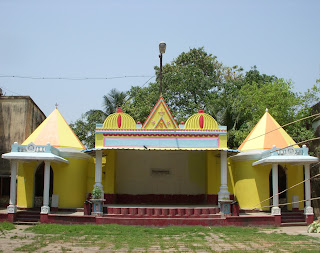
On the bank of a pond, the twin Shiva temples dedicated to Rakta-Kamaleshwar and Krishna-Chandreshwar were built by Maharaja Joynarayan Ghoshal Bahadur in the year 1781. Two large Shiva Linga each about 11 feet high are the reigning deities of the two temples. The temples look like they have been given a fresh coat of paint in recent times but the colours seemed a bit too bright and may be the old worn look which I have seen in some earlier photographs would have suited them more and be reminiscent of the bygone era of the Bhukailash zaminders. The temple architecture is that of the a simple aat-chala which is typical of Bengal.


Joynarayan Ghoshal (1752-1821) was born in Gobindapore and was well versed in Sanskrit, Hindi, Bengali, Arabic, Persian and English. According to a book, he was nominated by Nawab Mubarak Daulat to serve the provincial councils of Patna, Murshidabad, Dacca and Burdwan. He received a royal grant from the Emperor of Delhi, Mohammad Jahandar Shah and was conferred with the title of Maharaja Bahadur. As per a stone inscription nearby, he also held the post of a superintendent during the tenure of Police Superintendent John Shakespeare and was involved in benevolent activities along with Raja Rammohan Roy and Iswarchandra Vidyasagar.
The zaminder palace has been ruined and only a few pillars and the inner courtyard and nahabat-khana are reminiscent of the past.

A temple dedicated to Patit-Paboni (manifestation of Goddess Durga) and built in the year 1782 is situated inside the inner courtyard.


It is believed that Sadhak Ramprasad visited this temple and it is he who gave the name Bhukailash or Abode of the Gods on Earth.
On the bank of a pond, the twin Shiva temples dedicated to Rakta-Kamaleshwar and Krishna-Chandreshwar were built by Maharaja Joynarayan Ghoshal Bahadur in the year 1781. Two large Shiva Linga each about 11 feet high are the reigning deities of the two temples. The temples look like they have been given a fresh coat of paint in recent times but the colours seemed a bit too bright and may be the old worn look which I have seen in some earlier photographs would have suited them more and be reminiscent of the bygone era of the Bhukailash zaminders. The temple architecture is that of the a simple aat-chala which is typical of Bengal.


Joynarayan Ghoshal (1752-1821) was born in Gobindapore and was well versed in Sanskrit, Hindi, Bengali, Arabic, Persian and English. According to a book, he was nominated by Nawab Mubarak Daulat to serve the provincial councils of Patna, Murshidabad, Dacca and Burdwan. He received a royal grant from the Emperor of Delhi, Mohammad Jahandar Shah and was conferred with the title of Maharaja Bahadur. As per a stone inscription nearby, he also held the post of a superintendent during the tenure of Police Superintendent John Shakespeare and was involved in benevolent activities along with Raja Rammohan Roy and Iswarchandra Vidyasagar.

The zaminder palace has been ruined and only a few pillars and the inner courtyard and nahabat-khana are reminiscent of the past.

A temple dedicated to Patit-Paboni (manifestation of Goddess Durga) and built in the year 1782 is situated inside the inner courtyard.


It is believed that Sadhak Ramprasad visited this temple and it is he who gave the name Bhukailash or Abode of the Gods on Earth.


